

If you have ever walked the side streets of Carmel-by-the-Sea, you have seen sandblasted wood signs without necessarily knowing their name. They are the dimensional, textured signs hanging outside galleries, inns, and boutiques — the ones where the lettering stands raised above a background of natural wood grain you can actually feel with your fingertips. At Signworks, we have been crafting sandblasted wood signs on the Monterey Peninsula for 33 years. We know this process the way a vintner knows fermentation: from the inside, with calloused hands and hard-earned opinions about every step. Here is how these signs are actually made, and why nothing else quite compares.
What Is a Sandblasted Wood Sign?
A sandblasted wood sign is a dimensional sign created by using high-pressure abrasive media to selectively remove the softer grain from a piece of cedar or redwood, leaving the harder grain standing in relief. The result is a surface with genuine depth — raised lettering and graphics set against a textured, organic background that reveals the natural character of the wood.
People sometimes use “carved” and “sandblasted” interchangeably, but they are technically different processes. Traditional carved signs are shaped with chisels, gouges, and routers by hand. Sandblasting achieves a similar dimensional effect by working with the wood’s natural grain structure rather than cutting against it. The visual result is distinct: sandblasted signs have that unmistakable ridged texture in the recessed areas where the hard grain lines remain standing like tiny mountain ridges.
This technique has roots going back to 1870, when Benjamin Tilghman patented the sandblasting process after observing how wind-driven sand naturally etched surfaces in the desert. Sign makers eventually realized that the same principle could coax beautiful dimension out of softwood species — and a craft tradition was born that has defined the look of places like Carmel, Nantucket, and Charleston ever since.
Why Cedar and Redwood? The Science Behind the Wood
Not just any lumber ends up on our sandblast table. Western red cedar and coast redwood are the two species that make this craft possible, and both are native to the Pacific coast — California trees for California signs.
The reason these species work so well comes down to grain structure. Both cedar and redwood have a dramatic contrast between their earlywood (the softer, lighter growth from spring) and their latewood (the denser, harder growth from summer). When the blast media hits the surface, the soft earlywood gives way while the hard latewood stands firm. That differential hardness is the entire mechanism. Without it, you would just be destroying a piece of lumber.
Beyond the grain, both species bring natural rot resistance to the table. Cedar contains thujaplicins and redwood is rich in tannins — extractives that fight decay, insects, and fungal growth from the inside out. For a sign that will hang outdoors on the Monterey coast for decades, that built-in durability matters enormously.
Both woods also offer excellent dimensional stability, meaning they resist the warping, cupping, and splitting that plague other species as humidity swings through the seasons. Cedar is generally more available and cost-effective. Redwood tends toward a tighter, more uniform grain and is slightly harder. We work with both and can advise on which is the better fit for a given project — it often comes down to the specific grain character we are after.
How Sandblasted Wood Signs Are Made — Step by Step
This is where 33 years of shop knowledge earns its keep. Every sandblasted sign we build follows the same fundamental process, and every step matters.
Selecting the Lumber
It starts with kiln-dried cedar or redwood boards, typically 6-inch by 2-inch stock. We look for tight, consistent grain patterns — the kind that will sandblast cleanly and produce even, attractive texture. Knots, sapwood, and irregular grain get set aside. After three decades, you develop an eye for which boards will produce stunning results and which ones will fight you the entire way.
The Glue-Up
A finished sign is almost always wider than a single board, so we edge-glue individual boards together into a larger panel — similar to a butcher-block technique. The joints need to be dead flat, tight, and bonded with waterproof glue that can handle years of coastal weather. A sloppy glue-up will telegraph through the finished sign as a visible seam or, worse, fail entirely after a few seasons of fog and sun.
Cutting and Planing
The glued panel is cut to the dimensions the sign requires. Straight-sided signs go through the table saw. Shaped signs — arched tops, decorative profiles, the kind of custom silhouettes that give a sign real presence — are cut on the bandsaw. Then the entire panel goes through the thickness planer to achieve a smooth, dead-flat surface. Any unevenness at this stage will show in the finished product. There is no hiding it later.
Applying the Sandblast Mask
This is where the design meets the wood. We apply a sandblast-resistant mask — a rubber or vinyl resist material — to the face of the sign. The mask protects everything that will remain raised: the lettering, graphics, borders, and any decorative elements. The design is cut on a plotter and carefully transferred to the wood surface by hand.
Precision here directly determines the crispness of the finished lettering. A mask that shifts, lifts, or wrinkles during application will produce soft, fuzzy edges instead of the sharp, clean lines that distinguish professional work.
Sandblasting
We take the masked sign outdoors — sandblasting produces serious dust and debris — and blast it with high-pressure abrasive media. The soft earlywood grain strips away. The hard latewood grain resists and remains standing. The masked areas stay fully protected, smooth and raised above the newly textured background.
The depth of the blast is controlled entirely by technique: distance from the surface, air pressure, media type, and dwell time. We typically blast to a depth of 1/8 to 1/4 inch, depending on the wood species and the look we are after. Go too shallow and you lose the dimensional drama. Go too deep and you compromise the structural integrity of the panel. The sweet spot comes from experience — thousands of signs worth of experience.

Painting and Gold Leaf
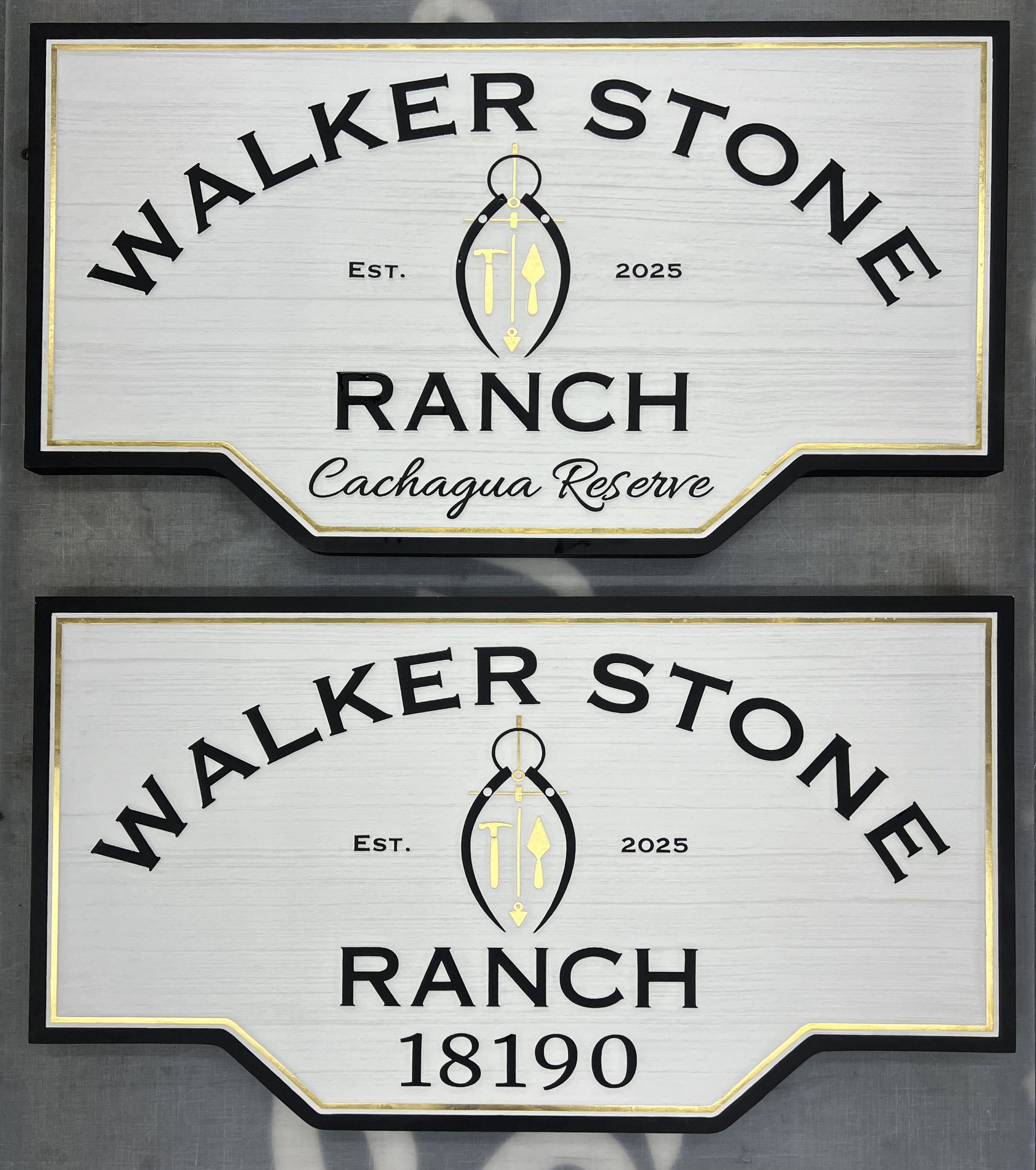
After blasting, the mask comes off and the real artistry begins. The dimensional quality of a sandblasted sign creates a natural opportunity for multi-tone finishing — raised elements painted one color, recessed background another. We hand-paint our premium signs with exterior-grade enamel, carefully selecting colors that will read well from a distance while holding up to coastal UV exposure.
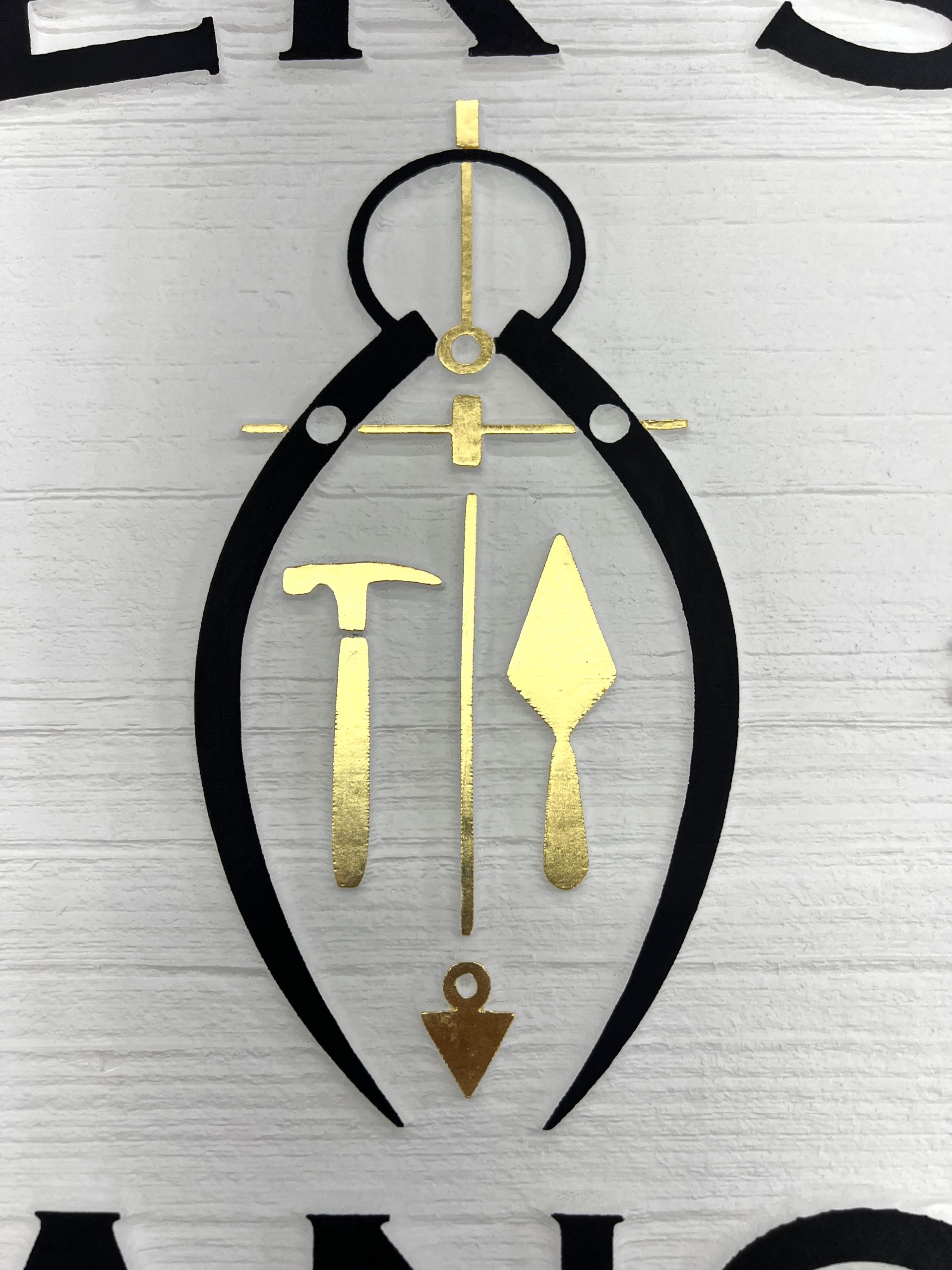
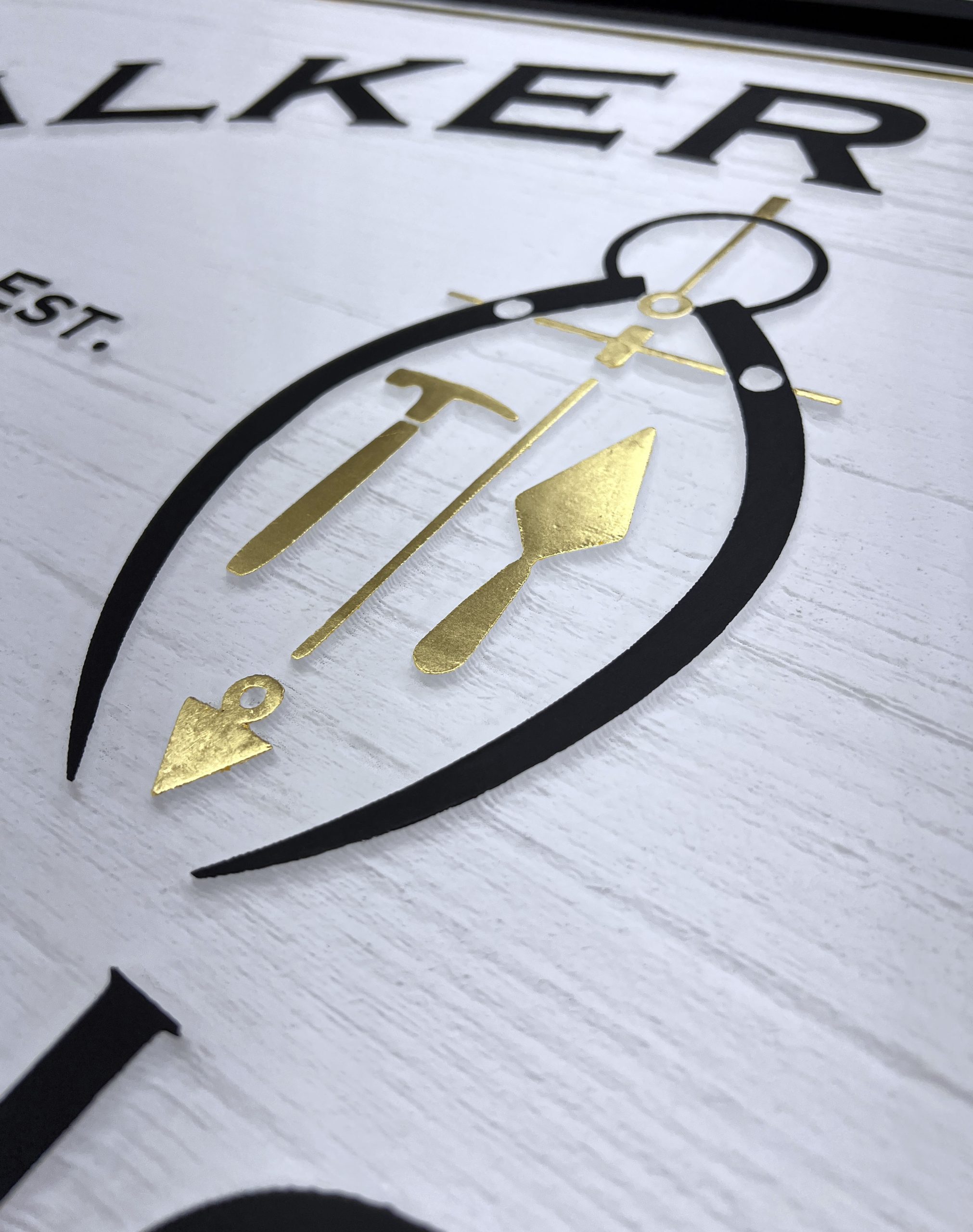
For the highest tier of work, we apply genuine gold leaf. This is 23-karat gold, beaten to sheets roughly 0.1 microns thin — so delicate that a breath will send them sailing across the room. The surface is sized with adhesive, allowed to reach the right tack, and then each leaf is laid by hand and burnished into place. Gold leaf on a sandblasted sign is typically applied to raised lettering, borders, or graphic elements, where the contrast between gleaming gold and the natural wood texture creates something no metallic paint can touch. Genuine gold has a warmth and depth that is immediately recognizable.
Sealing for the Coast
The final step is critical, especially here on the Monterey Peninsula. We seal the finished sign with a UV-resistant marine-grade clear coat — typically a spar urethane — that protects the paint, gold leaf, and wood from salt air, sun, fog, and the constant wet-dry cycles of the California coast. Every surface gets sealed: the face, the edges, and the back. Moisture will find any gap you leave, and once it is inside the panel, the swelling-and-cracking cycle begins.
Our 33 years working in this specific coastal environment means we know exactly which finishes hold up and which ones will chalk, peel, or yellow within a few seasons. That is not something you learn from a product data sheet. You learn it from maintaining signs for three decades and seeing what lasts.
Sandblasted vs. CNC-Routed Signs — How to Choose
We get this question often, and the honest answer is that both processes produce excellent signs — they just create very different aesthetics.
Sandblasted signs have that organic, textured feel. The natural grain pattern is visible in the recessed areas, giving the sign warmth and a handcrafted quality. They are best suited for traditional settings: village storefronts, coastal inns, ranch properties, wineries, and any context where natural materials and artisan character matter.
CNC-routed signs have smooth, machined recesses with uniform depth. They are clean, precise, and architectural — ideal for contemporary businesses, corporate settings, and designs with highly detailed logos that require exact reproduction.
The two processes are complementary, not competitors. A boutique hotel in Carmel might want a sandblasted redwood sign for its old-world charm. A tech company in Monterey might want CNC-routed dimensional letters for a modern look. We build both and regularly help clients determine which approach best fits their property, their brand, and their setting.
Why Sandblasted Signs Still Define Carmel, Monterey, and the Central Coast
Carmel-by-the-Sea did not end up with beautiful signs by accident.
The city’s sign ordinance is among the most restrictive in the country, prohibiting neon, internally illuminated signs, and most types of projecting or roof-mounted signage. Materials, colors, and design all require approval. The intent is to preserve the village character that has made Carmel famous — and it has worked. The practical result is that Carmel businesses have turned to handcrafted wood signs, sandblasted, carved, and hand-painted, as the primary way to identify themselves. Walk down Ocean Avenue or any of the side streets and you are surrounded by them. They are as much a part of Carmel’s identity as the cypress trees and the white-sand beach.
This is not unique to Carmel. Across the Monterey Peninsula — from Cannery Row’s maritime heritage signage to the understated estate markers of Pebble Beach and the Del Monte Forest — sandblasted wood signs endure because they match the character of the places they serve. In a landscape where vinyl banners and backlit plastic would feel tone-deaf, a sandblasted cedar sign feels like it belongs.
There is also a practical longevity argument. A well-made sandblasted wood sign, properly sealed and maintained, lasts 20 to 30 years or more. The upfront investment pays for itself many times over compared to cheaper signage that needs replacement every few years. When we deliver a sign, we expect it to be hanging long after the paint on the building behind it has been refreshed two or three times.
What to Look for in a Sandblasted Sign Maker
If you are considering a sandblasted wood sign, the quality of the finished product depends almost entirely on the person making it. A few things worth asking about:
Experience with the specific wood species. Not every sign shop works with natural cedar and redwood. These materials have quirks — grain variations, moisture behavior, finishing requirements — that only hands-on experience teaches.
In-house painting and gold leaf capability. Many shops outsource their finishing work. When the fabrication, painting, and gold leaf are all done under one roof, quality control is tighter and the result is more cohesive.
Understanding of local conditions. A sign built for the Arizona desert and a sign built for the Monterey coast face very different environmental stresses. Salt air, UV exposure, and fog cycles all factor into material selection, glue choice, and finishing systems.
Familiarity with local sign codes. Carmel’s permitting process, in particular, is notoriously detailed. Working with a sign maker who knows the municipal code and has a track record with the planning department saves real time and frustration.
We have been building sandblasted wood signs on the Monterey Peninsula for over 33 years. If you are thinking about a custom wood sign for your business, property, or estate, we would be glad to talk through the options. Give us a call or stop by the shop — we are always happy to geek out about grain patterns and gold leaf.

Leave A Comment