


If you own or manage a multi-tenant commercial property, there’s a good chance you’ll need a Master Sign Program. If that property is in Carmel-by-the-Sea, you’ll definitely need one.
A Master Sign Program — or MSP — is a comprehensive signage plan that covers every sign on a property: types, sizes, materials, locations, and design standards. It gives the property owner control over design cohesiveness, gives the city confidence that everything stays within their guidelines, and gives each tenant a clear guide for what kind of sign they can order. Tenants still need to apply for their own sign permits — but the MSP makes that process straightforward because the rules are already defined.
Why Carmel Requires Them
Carmel has one of the strictest sign ordinances in California. No internally illuminated signs. No neon. Strict size limits. Every sign application goes through the Design Review Board. Without an MSP, a multi-tenant property risks ending up with a mismatched collection of signs — one tenant gets a modern acrylic panel, another hangs a rustic wood slab, and the property looks like it has no plan. Because it doesn’t.
The MSP solves that. It’s the rulebook for the property’s signage — what materials are allowed, what sizes, what styles, where signs go. The city requires it, the property owner enforces it, and tenants use it as their guide.
The Hampton Court Project
Hampton Court is a multi-tenant commercial courtyard at the corner of San Carlos and Seventh in Carmel-by-the-Sea. The property houses a mix of tenants — a gallery, a wine tasting room, a salon, a leather boutique, and the Monterey Symphony offices. Each business needs signage. All of it has to look like it belongs together, and all of it has to pass Carmel’s design review.
We designed the entire MSP and have fabricated the new signs for the property since it was approved.
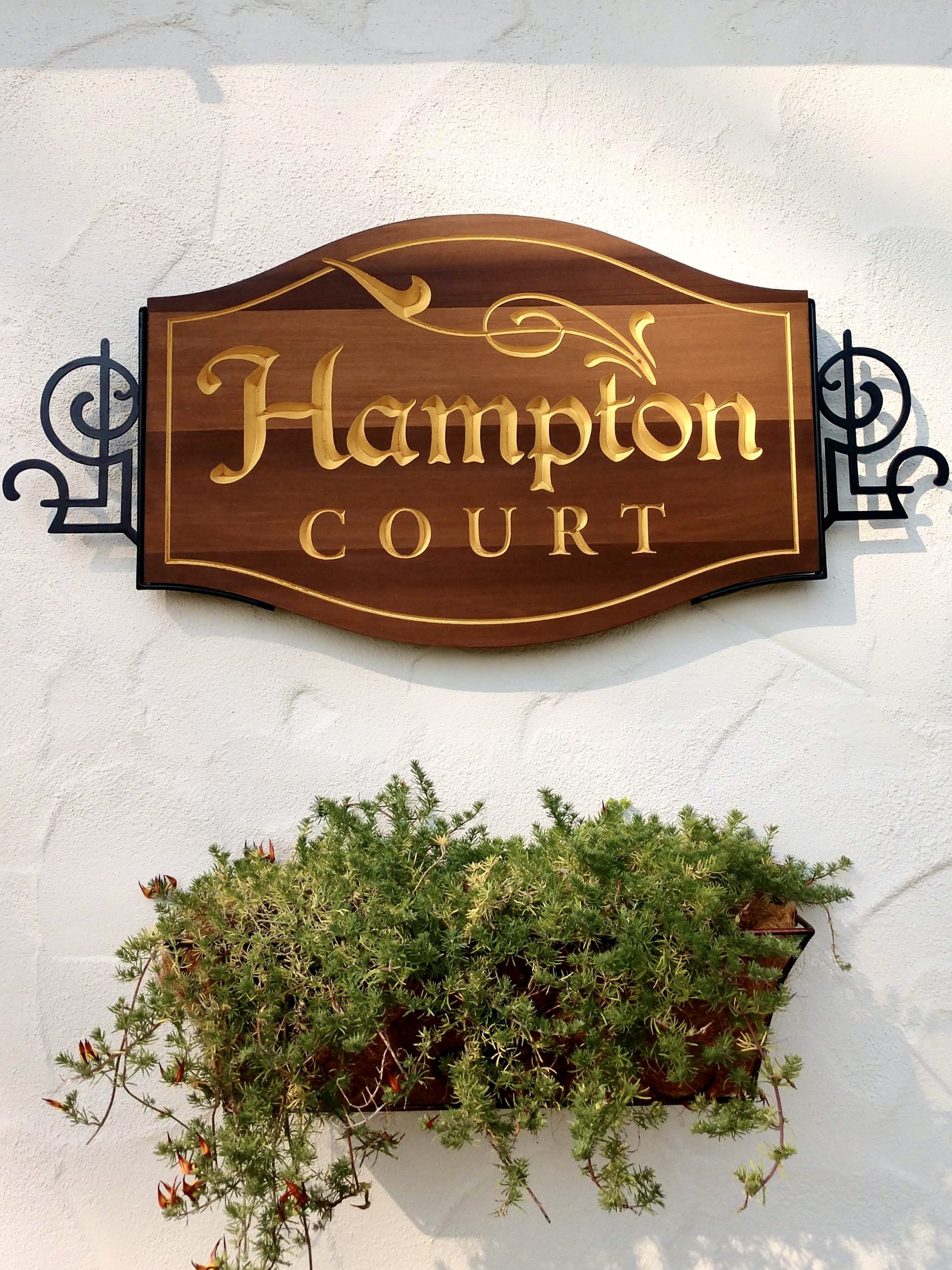
Close-up: routed cedar, metallic gold paint, custom wrought iron brackets.
The primary wall sign is a 29″ x 19″ piece of 1.5″ thick routed cedar, finished with a dark brown stain and metallic gold lettering. It mounts on custom wrought iron scroll brackets against the building’s stucco wall. The design fits the cottage architecture that defines Carmel’s commercial village.
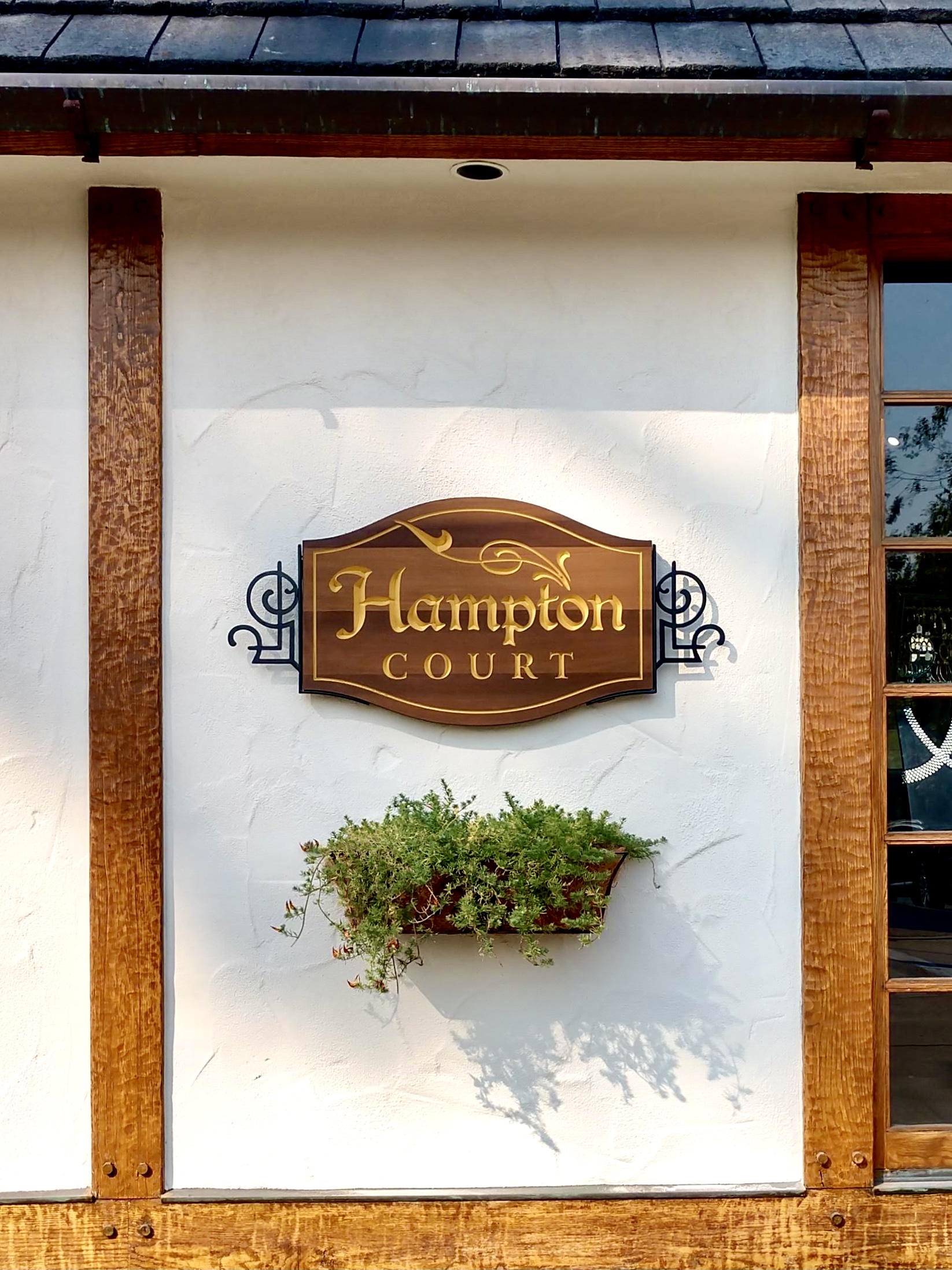
The wall sign in context — stucco walls, exposed wood beams, slate roof. The sign was designed to fit the building, not just hang on it.
The two-sided directory faces Seventh Avenue and serves as the main tenant listing. The header is stained cedar with V-groove routed lettering. Below that, a custom steel frame with wrought iron details holds individual tenant panels — each one a 17-1/8″ x 4.75″ piece of 1.75″ thick wood with sandblasted or V-groove routed lettering.
The tenant panels are designed to slide in and out. When a tenant changes, the property owner swaps one panel — not the whole sign. That’s not an afterthought. That’s engineering for how multi-tenant properties actually work.
The tenant sign guidelines give each space options for individual signage — hanging blade signs, wall-mounted beam signs, or window graphics — all in sandblasted or routed wood, up to 2 inches thick. The design and colors can vary by tenant, but the materials and style stay consistent across the property.
Total sign area for the entire property: 36 square feet. Every square foot accounted for, specified, and approved.
What the MSP Document Includes
The program we submitted to the city runs seven pages: a cover sheet, a summary of all sign types and sizes, an aerial site plan showing every sign location, detailed specifications for the primary wall sign and directory, and elevations for each tenant sign position — including hardware details down to the threaded studs and bracket dimensions.
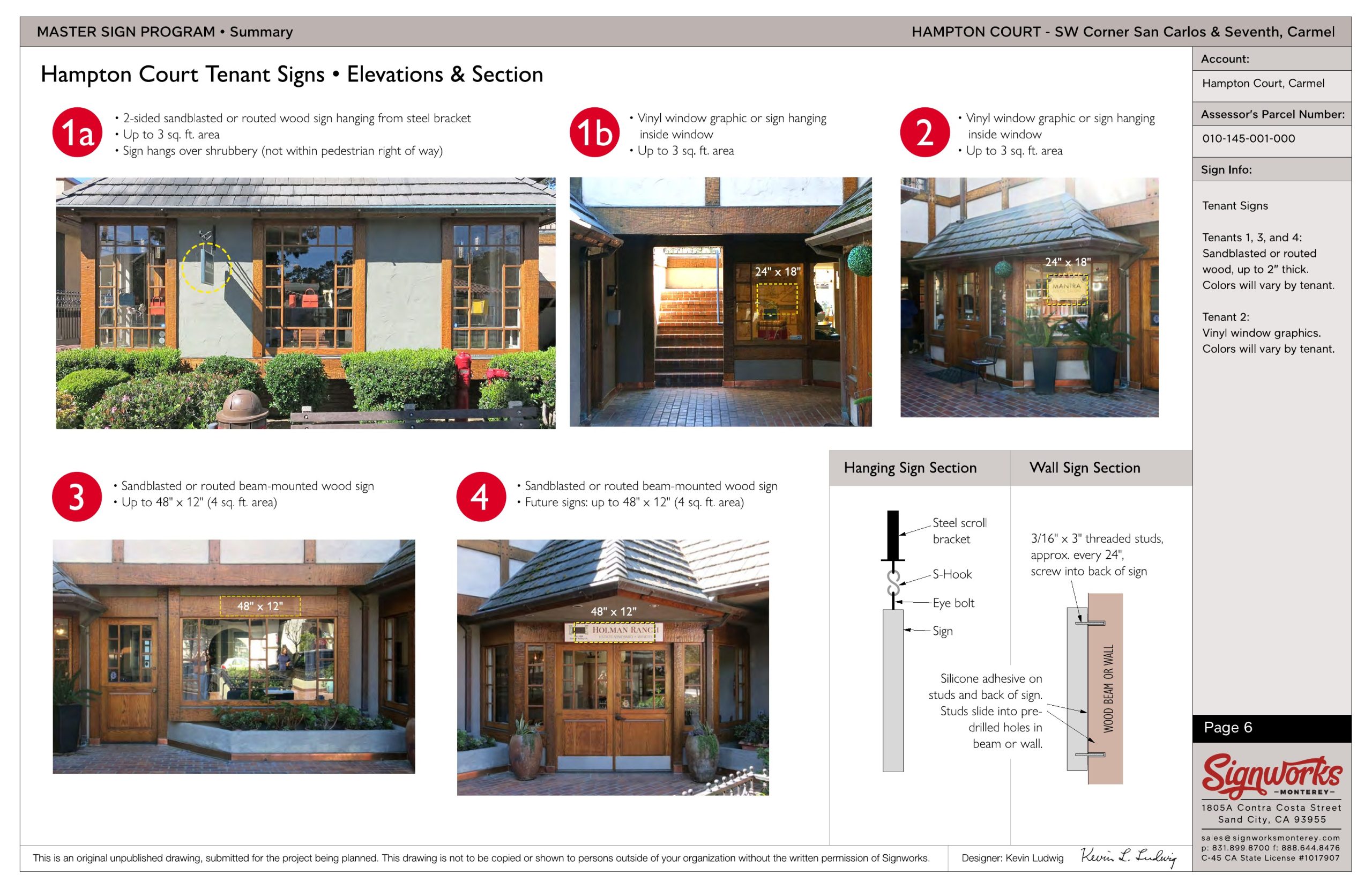
One page from the Hampton Court MSP — tenant sign elevations, mounting hardware cross-sections, and specifications submitted to the City of Carmel.
That’s the level of documentation Carmel’s planning process expects. We’ve been doing it for 33 years.
The Takeaway
A Master Sign Program isn’t just paperwork — it’s the plan that keeps a property’s signage consistent, compliant, and looking like it belongs. For properties in Carmel, where the design review process will reject anything that doesn’t meet the standard, having a sign company that knows the code and knows the commission makes the difference between a smooth approval and months of revisions.
If your property needs a sign program, give us a call.

Leave A Comment